
A strong and competent organisation
The CSF as an active social influencer
National Cancer Strategy. In 2024, the main focus of social influence was on launching and developing a National Cancer Strategy. Work on the strategy began in May 2024 as a result of long-term advocacy, when the Ministry of Social Affairs and Health tasked the Finnish Cancer Information Centre (FICAN) with preparing the strategy. The CSF played a key role in this throughout the year. The steering group for the National Cancer Strategy consisted of the secretary general, the director of the Finnish Cancer Registry, and the public relations manager. Numerous representatives of the CSF served as chairs of the working groups, as well as members of the working groups.
EU election advocacy. In the spring EU elections, the Non-Communicable Disease (NCD) Alliance ran a joint social media campaign based on the election goals prepared together the previous autumn. Public health organisations also took a joint stand on the EU elections with the theme “Safety is also health and functional capacity.” Once Parliament began its work, we lobbied from a cancer perspective in connection with the hearing of the new Health Commissioner.
FICAN cooperation. Traditional FICAN cooperation days focusing on psychosocial support were organised with the National Cancer Center. There were over 80 participants. Throughout the year, we collaborated closely with the coordinating unit of the National Cancer Center in preparing the National Cancer Strategy. The National Cancer Forum, organised in cooperation, brought together Finnish cancer field actors to discuss the progress of the national cancer strategy work. There were about 100 participants on site and about 200 participants followed the event remotely. In addition, a patients’ day was organised for people with rare cancers.
Government Programme highlights the need for advocacy. The CSF actively monitored the proposed changes to the Alcohol and Tobacco Act, issued statements and wrote about these topics. An expert from the CSF was also heard by the Parliament’s Social Affairs and Health Committee in connection with the amendment of the Tobacco Act. We continued to work with Ash Finland and the Finnish Association for Substance Abuse Prevention (EHYT) to lobby on the issue of nicotine pouches. In alcohol policy, we highlighted the link between alcohol and obesity and cancer risk, for example at a stakeholder event organised by Alko Inc, the national alcoholic beverage retailing monopoly, and in communications related to the Nordic CAPOC project’s citizen survey. Information on the cancer risk associated with obesity was provided several times during the year.
In connection with the negotiations on the spring budget, we published a joint statement on health-based taxation with the Non-Communicable Disease (NCD) Alliance, as well as our own statement on organisational cuts. We also ran a social media campaign linked to the budget negotiations onthe theme “Cuts to organisations are cuts to support for cancer patients and their loved ones.” We immediately commented on the funding cuts announced in the budget negotiations after the negotiations and in a joint statement with the NCD Alliance on 25 April. A joint breakfast event was also held with the network at SuomiAreena 2024 on the implementation of the Terveydeksi National Health and Wellbeing Programme, which was also commented on in a press release.
The Council and Board of the CSF took a joint stand during the organisation’s conference on the treatment of elderly cancer patients and the need for psychosocial support and palliative care, and called for a national debate on the care and quality of life of the elderly.
Efforts to promote palliative care legislation also continued, in collaboration with the Finnish Association for Palliative Medicine and the Finnish Association for Palliative Care, through a meeting with the Minister of Social Affairs and Health, Kaisa Juuso, and her special advisors. In connection with the August budget session, the CSF approached all MPs with a statement reminding them of the rapidly growing number of people over 75 with cancer, and the need for care, family care, and skilled palliative care. The statement also emphasised the need for end-of-life care leave for loved ones to be quickly implemented. CSF also participated in an event held in Parliament on end-of-life care leave. A statement on the need for legislation on palliative care was also published during International Palliative Care Week.
Advocacy needs related to organisational funding. During the spring 2024 budget negotiations, the effects of cuts to organisational funding were communicated to Minister Juuso, his special advisors, and Mika Pyykkö, who conducted a study on organisational funding during the autumn.
Introduction of the Finnish Transparency Register. In 2024, Finland introduced the Transparency Register, which is administered by the National Audit Office. All organisations engaged in advocacy work were required to register by the end of March. Under the new legislation, advocacy activities were reported to the Transparency Register for the first time in July–August, initially only for activities carried out in April–June. Much time was spent on implementing and familiarising ourselves with it. At the end of the year, the CSF also commented on the reporting of financial information in the Transparency Register, emphasising the need to reduce the administrative burden.
Parliamentary cooperation. The Parliamentary cancer network was launched at the end of 2023 during this electoral term, and the new public relations manager met with Sari Sarkomaa MP and her assistant Sonja Tamminen in the spring. An event on the national cancer strategy was planned for 2024 but was postponed to the following year.
Advocacy work for the regional and municipal elections. Preparations for the 2025 regional and municipal elections began with the formulation of common regional and municipal election goals for the NCD Alliance, which were published on the network’s website. Themes related to access to treatment, health promotion and organisational cooperation were also presented at the Kuntamarkkinat (Municipal Fair) at a joint presentation stand.
Advocacy work on pharmaceutical policy. We participated in the work of the Association of European Cancer League’s Access to Medicines Working Group and followed the work of the European Fair Pricing Network (EFPN).
Nordic cooperation. The network of Nordic cancer societies, the Nordic Cancer Union, began preparing for advocacy cooperation in 2024. The Head of Public Affairs actively participated in the preparation of the new Nordic Advocacy Task Force Group.
Updating the social policy paper. In spring 2024, it was decided that the policy paper would be updated only after the National Cancer Strategy and the new CSF strategy had been completed in 2025.
Sustainability programme. The Head of Public Affairs began preparing the continuation of the unfinished sustainability programme and received training in the basics of responsibility management and reporting. Preparation of the sustainability programme will begin in 2025 with the environmental component. To this end, a cooperation agreement was signed with the EkoCompass environmental management system.
Other advocacy work. The CSF has actively participated in social debate through the publication of opinion columns on various topics throughout the year:
- Important support persons in palliative care, Keskisuomalainen, response 28.2.2024
- Public health forgotten in the government’s alcohol policy, HS 10.3
- Young people’s health and well-being not a priority in alcohol law reform, Maaseudun tulevaisuus 6.4.
- The right to palliative care must be guaranteed by law, Helsingin Sanomat 12.4.
- CSF trains volunteers to support critically ill people, Helsingin Sanomat, October 28.
- Alcohol also increases cancer risk through obesity, Helsingin Sanomat, December 10.
- Finland is making a big mistake with its Tobacco Act, Helsingin Sanomat, December 28.
Statements. A total of 10 statements were issued in 2024:
- Statement on amending the Alcohol Act (to the Social Affairs and Health Committee)
- Statement on the funding of social and health associations and foundations (to the Ministry of Social Affairs and Health)
- Statement on the decision of the Service Selection Council on the criteria for mammography screening of asymptomatic individuals (Ministry of Social Affairs and Health)
- Statement on the processing of social and health care client data (Ministry of Social Affairs and Health)
- Statement on the draft national nutrition recommendations (National Nutrition Council)
- Statement on amendments to certain regulations issued under the Tobacco Act (Ministry of Social Affairs and Health)
- Statement on social and health care client fees (Ministry of Social Affairs and Health)
- Statement on the alcohol and alcoholic beverage tax (Ministry of Finance)
- Statement on amendments to the Alcohol Act (home delivery) (to the Ministry of Social Affairs and Health)
- Statement on the compilation of financial data for the transparency register (to the National Audit Office)
Common management practices
The management team meets twice a month to discuss key common issues and receive reports from the units. Supervisor meetings focus on operational planning, budgeting, and issues affecting the organisation as a whole. The units’ own meetings are arranged in a manner appropriate to the nature of each unit. Cooperation between units takes place through projects and separate working groups.
The CSF operates on the principle of multi-location working. The units have agreed on days when they work in the office.
A key part of the CSF’s activities are the joint executive director forums of the central organisation and member organisations, which deal with common strategic and current issues.
The CSF uses the Proppu project model, which has been modified from the original waterfall model and the agile methods associated with it to create a hybrid model. The key principles of the model are transparency and continuous development. The project manager familiarises new project managers with the use of the project model, tools, and document templates.
The Project Office (project steering group) approves project planning documents to ensure that the objectives are realistic in terms of definition, measurement and risk considerations. The steering group then develops the model based on feedback from projects.
The Project Portfolio is a tool that contains information on all completed and ongoing projects and their current status.
Projects related to the development programmes for the 2020-2025 strategy period
Branding and marketing of psychosocial support and services. The project aimed to improve awareness of the psychosocial support services provided by the CSF by building a new service brand. We launched the Luoto brand internally at the spring Cancer Society Days, and the marketing materials and Luoto website were completed by the end of the year.
Developing membership and strengthening recruitment. The project aimed to halt the decline in membership of associations and to strengthen their membership base. Among other things, the project produced a membership elevator pitch and compiled good practices to support the associations’ recruitment of new members. A joint membership recruitment campaign was also carried out to attract new members.
Strengthening the CSF’s fundraising. The project was suspended when the changes to STEA funding for the coming years became known. We began long-term financial planning for all member associations under the leadership of the Chief Financial Officer.
Tutka – the development of the Cancer Registry’s research and expert services. This multi-year project aims to develop the content and usability of information services to better meet the needs of researchers and healthcare professionals who work with cancer patients, in order to strengthen cancer research and prevention efforts. The services will produce new statistical analytics and data presentation formats for different target groups.
Cancer Registry in a secure data environment. In 2024, the Finnish Cancer Registry’s data repository was transferred to Telia’s secure environment. The processing of directly identifiable data is now restricted and separated from the processing of pseudonymised data. Our ability to operate depends on the trust of our clients and the general public our the secure processing of data provided to cancer organisations.
Organisational activities and Cancer Foundation Finland’s support for member associations
Organisational activities focus on developing internal cooperation and standard operating procedures. It is important to identify the topics and activities that strengthen our organisation’s national presence through cooperation. For example, we have sought to address the decline in membership through joint membership campaigns, among other measures. By the end of 2024, the total membership of the CSF stood at 96,994.
Organisation Committee and meeting of Executive Directors. The Organisation Committee and regular executive director meetings play a key role in the development of the organisation. The most important organisational issues are discussed in both forums. The Organisation Committee, appointed by the CSF Board, supports the Board in its decision-making. Each member association takes turns at appointing a representative to the Organisation Committee, which in 2024 was chaired by Annikki Thodén. The Organisation Committee met four times during the year.
The Executive Directors’ Meeting is an interactive forum for coordinating and bringing together the CSF’s main officials. Six meetings were held in 2024, in addition to which remote meetings were held approximately every two weeks. All of them were chaired by Anne Lindfors, Executive Director of the Cancer Society of Pirkanmaa, and Anu Niemi, Executive Director of the Breast Cancer Association. These meetings play an important role in the planning, implementation, and development of joint activities.
Two executive director meetings were held in Swedish. The Cancer Society of Ostrobothnia was responsible for coordinating Swedish-language activities nationally.
Organisational activities steering group. A steering group for organisational activities was established in 2024. Its task is to incorporate the views of member associations more effectively into the planning and prioritisation of organisational activities.
Cancer Society Days and skills development. Every year, Cancer Society Days bring together the elected officials and staff of the associations to discuss important current topics concerning the CSF. In 2024, these days were held in Lappeenranta. In addition, smaller training events were organised to develop staff skills and establish common practices.
A training day and monthly training meetings were organised for the office staff of member associations.
Support for cancer work. The annual support granted by Cancer Foundation Finland to the CSF member associations is already an established practice for providing practical advice and support to patients and their loved ones. Support for cancer work mainly focuses on covering the remunerative costs of psychosocial support. Cancer Foundation Finland contributed €725,000 to this work. Funding for cancer support is channelled from the foundation’s operating fund. Member associations apply for grants annually and report on the use of the previous year’s grants.
One of the foundation’s goals is to enable equal cancer support services across Finland. Cancer support has been focused particularly on the core activities of member associations, which play an important role in supplementing public social and healthcare services. Support for cancer work focuses on, psychosocial support, counselling, and information, areas in which the public sector is rarely able to provide in such comprehensive services.
The effectiveness of the support is measured through annual reporting, including the number of events or patient encounters. The quality of services is assessed through client surveys. Grant activities are reported as part of the member organisation’s annual report and financial statements.
The guidelines of the 2023 C will be used when assessing the use of its funding, needs, effectiveness, impact, and local needs.
Joint statistics. Joint statistics for the CSF will be developed to enable comparable data to be collected.
Personnel
Objectives. The goal of the CSF as an employer is for its personnel to enjoy their work, be committed and motivated, and receive sufficient and timely support for their work and the development of their skills. We invest in personnel development and are a training-friendly work community. It is important to us that our employees enjoy working for us and would recommend us as an employer.
During the operating year, 34 new employment relationships began (including summer workers and interns) and 26 employment relationships ended. In 2024, we worked the equivalent of 103 person-years, and at the end of the year, we had 110 employees.
New premises. The first half of 2024 was busy with planning and preparing for the renovation and interior design of our new premises. In April, our office moved to Mäkelänkatu.
Well-being at work. Based on the results of the latest Great Place to Work (GPTW) survey, we continued to work on our well-being at work plan during 2024. The final version was presented to the staff at a staff meeting.
The office move required occupational health care to conduct a workplace survey, which Mehiläinen Working Life Services carried out in November 2024. This included a staff questionnaire, the results of which were received in December.
A working group composed of representatives from all departments drew up rules for the new office to guide practical office life.
Information management, data protection and data security
The aim of IT management is to improve efficiency and ensure the dependability of the ICT infrastructure and services. To this end, we moved to a Katakri-audited data centre and upgraded our server hardware and virtualisation platform. IT management also participated in the design of our new premises, the move, and the implementation of new technical solutions in the office.
Järkkäri joint operations management system for member associations. The development of the Järkkäri system continued throughout 2024. The system’s statistics were improved, member billing processes and the technical platform were updated, and new features were introduced.
In the Finnish Cancer Registry’s data system project, the development of the Skriinar quality assurance application and the Cansta cancer coding support application continued based on end-user feedback. The scrAll project, which standardises and streamlines reporting in the Cancer Registry, continued to support reporting. In addition, the Cancer Registry participated in the implementation of the SNOMED CT classification system for pathology and prepared for its introduction.
Data protection and data security. The CSF is subject to the information security requirements of the state authorities for the registration and statistics of the cancer and mass screening registries. The processing of personal data complies with the General Data Protection Regulation and the Data Protection Act, and special provisions on data protection. We actively monitor changes in legislation, VAHTI best practice support materials, the Katakri information security audit criteria of the authorities, and the guidelines of the data protection authority.
The guidelines for information security apply to all personnel. Data protection and security are handled by the Data Protection Officer, the Data Security Manager, a technical information security consultant, and an information security group that deals with data protection and information security issues.
The Data Protection Officer and Information Security Manager provided training on data protection and information security matters to 27 new employees. Data protection guidelines on the receipt and delivery of information were drawn up and made available to staff.
In 2024, work began on mapping data resources, information systems, and information security requirements. In addition, data protection agreements were concluded with processors of personal data for outsourced personal data processing activities. The seventh data balance sheet of the Finnish Cancer Registry was published. Member associations were advised on data protection issues.
Technical data security. Data management switched to using a Katakri-audited data centre for server hardware and at the same time renewed the firewall. External DNS services were transferred to an external service provider, which also significantly improved DDOS protection for websites. A new VPN solution and Azure Virtual Desktop were taken into trial use. In addition, existing data security threats were addressed by making changes to the systems.
Finance and administration
In finance, the focus was on providing basic financial services and stabilising financial processes. The current financial system was also developed in collaboration with the system supplier. In addition, investment activities and reporting were further developed both in cooperation with external partners and through internal operational development.
In addition to reforming financial reporting, short-term financial planning in terms of budgeting and forecasting was enhanced. Long-term financial plans were drawn up for the CSF and will be updated as strategy work progresses.
Funding development. CSF funding is partly linked to developments in the national economy. State subsidies are expected to decrease, particularly in STEA-funded activities. The state subsidy from THL for the operation of the Finnish Cancer Registry was maintained at over €1 million for the time being. Additional funding for the year was allocated to mass screening and screening activities and their development, as well as to quality work. The national level of STEA grants will decrease further in 2026-27 due to early savings in 2025, which is also likely to reduce the CSF’s share.
Fundraising
Goals and results: In 2024, Cancer Foundation Finland aimed to raise €16.6 million through donations and corporate agreements. The three cornerstones of fundraising were regular donations (i.e. monthly donations), the Pink Ribbon Collection and bequests. As in the previous year, the operational focus for 2024 was on corporate fundraising, with a new focus on strengthening bequest fundraising. The latter was achieved by recruiting a bequest and major donor manager. The corporate fundraising team strengthened its services to companies, in particular by enhancing the use of the CRM system to engage corporate partners and manage them professionally.
Cancer Foundation Finland’s fundraising income totalled €41.3 million, of which €28.4 million came from bequests. Administrative and fundraising costs totalled 11% (2023 24%). The extremely positive results of fundraising and bequest income strengthen Cancer Foundation Finland’s role as a significant funder of cancer research and as a provider of support services and cancer care through the CSF.
Bequest donations. The year 2024 is historic with bequest income of €28.4 million. Adding to the historic nature of this is the fact that notifications of wills made to Cancer Foundation Finland increased during the current year, which is likely due to Cancer Foundation Finland’s strong visibility, the age structure of our population, the growth in bequeathed assets and, above all, the desire of Finns to find a cure for cancer.
Regular donations. At the end of the year, Cancer Foundation Finland had 40,000 monthly donors. The main means of recruiting new monthly donors were the annual Pink Ribbon Dancing with the Stars programme and strong online and telemarketing. The in-house telemarketing team continued their work alongside an external telemarketing company. The donor service provided professional service to new and existing donors, ensuring that payments were correct and timely.
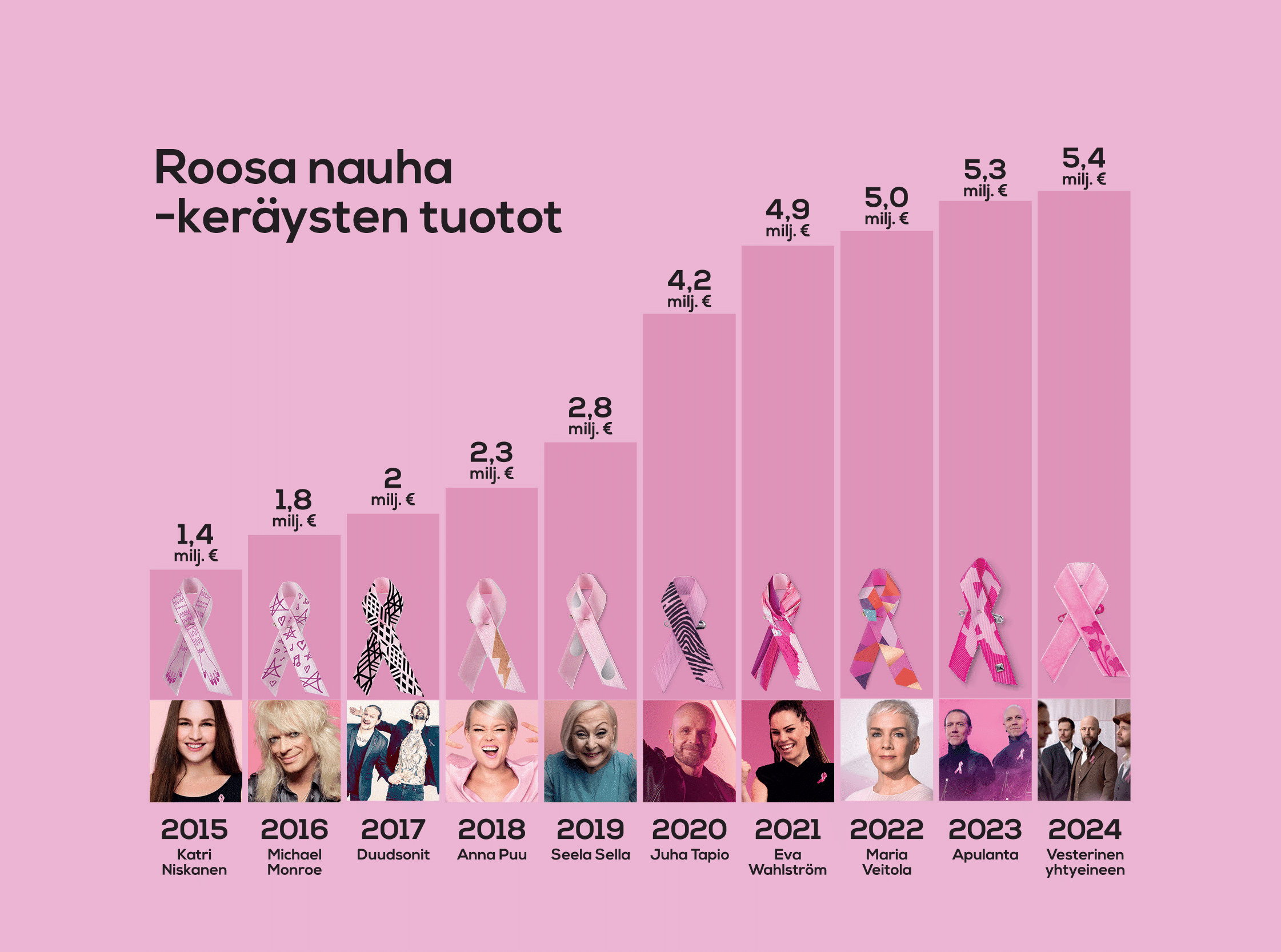
Pink Ribbon campaign. In 2024, the Pink Ribbon and wristbands were designed by Vesterinen Yhtye. The theme of the campaign was the slogan “Let hope live.” For the fifth year, the proceeds from the Pink Ribbon campaign will support research into all types of cancer and not only breast cancer. Lung cancer was selected as the research theme.
The campaign kicked off with a launch event attended by over 100 people at Musiikkitalo, hosted by Vappu Pimiä. The campaign ran throughout October and ended with a live broadcast of Pink Ribbon Dancing with the Stars. During the programme, €1.6 million was donated and 1,500 people pledged to become monthly donors. Before the live broadcast, the fundraising team organised a pre-party, which was attended by about 300 people. The guests were Roosa Nauha’s corporate partners, stakeholders, and volunteers who had participated in the campaign.
The Pink Ribbon Campaign’s post-campaign marketing began immediately at the start of November and continued until the start of the Christmas Collection. The Pink Ribbon results were announced on 4 February, marking the start of the Pink Ribbon Thank You Weeks. The campaign’s goal was to raise €4.2 million for domestic research, but the Pink Ribbon Campaign surpassed this goal, raising a record-breaking €5.4 million.
Christmas Collection. The last fundraising campaign of the year – the Christmas Collection – raised funds for cancer research. The faces of the Christmas collection were Olga Temonen, who has brain cancer, Saaga Nieminen, who has leukemia, and her mother Tiiu Nieminen, as well as cancer researcher and assistant chief physician Artturi Mäkinen. The Christmas charity market is very competitive. Despite Cancer Foundation Finland’s modest marketing budget, we almost reached our target for the Christmas campaign.
Munien puolesta (For the balls) fundraising campaign for prostate and testicular cancer. Renewal and the courage to evaluate new target groups are part of the long-term fundraising plan. Starting in spring 2023, a campaign aimed at men was planned, which would differ from the Pink Ribbon campaign in terms of its tone, boldness, target group and partners. This was the first time the campaign had been organised. It raised funds for prostate and testicular cancer research and raised awareness of these cancers.
The face of the campaign was ice hockey coach Jukka Jalonen. In addition, ice hockey player Jimi Suomi shared his own story during the campaign, and cancer researcher Antti Rannikko was also involved. The fundraiser was organised in collaboration with MTV and the Finnish Ice Hockey League Liiga. The men’s clothing company Black Horse was the corporate partner. In its first year, the fundraiser reached its budget target. The collaboration with MTV and Liiga will continue for three years.
Cancer Foundation Finland’s Celebrations Committee. The chair of the Celebrations Committee for 2024 was Jussi Vuori, better known to the general public by his stage name Jussi69. The Celebrations Committee arranged two events for Finnish cancer research. In April, an Afternoon Tea charity event was held at the House of Nobility in Helsinki, featuring a traditional English tea party. In August, the Celebration Committee invited guests to the Kalastajatorppa Tennis Club for charity and tennis. The Celebration Committee’s fund awarded a grant worth €20,000 to Associate Professor Michael Jeltsch. The Celebration Committee has a fund named after it at Cancer Foundation Finland, to which thousands of euros in ticket sales and lottery proceeds from events were directed again this year.
Strengthening and marketing Cancer Foundation Finland’s brand. The Cancer Foundation manages two brands: Cancer Foundation Finland Collection and the Pink Ribbon. The development and awareness of the Cancer Foundation Finland brand continued with a brand campaign that incorporated marketing and communication automation. The aim was to provide timely and relevant content to citizens interested in our activities. All content production related to fundraising products was also designed to strengthen the brand, increase awareness and enhance credibility.
Cancer Foundation Finland’s sub-brands, the Munien puolesta collection and the Christmas Collection, were developed in a target group-oriented manner so that they would implement the values and visual appearance of their parent brand in a controlled manner.
The management of the Pink Ribbon brand was developed by creating metrics and a monitoring model for how citizens and donors perceive the brand. In connection with the Pink Ribbon campaign, a so-called thank you campaign was also organised to communicate the results of the campaign and the use of funds.
Cancer Foundation Finland’s communications. Cancer Foundation Finland’s brand was also strengthened in a systematic and goal-oriented manner through communications: external communications focused on core messages on a quarterly basis, donor and campaign communications supporting the collections, and extensive media coverage. In addition, diverse content was produced for the communication of the Munien puolesta (For the balls), the Pink Ribbon Collection, and the Christmas Collection. The Cancer Foundation’s celebration committee was supported with communication through the foundation’s channels. At the end of the year, the grants and recognition awards awarded by the foundation were announced.
The expertise of cancer organisation experts was also used in media work. The goal of the foundation’s communications is to maintain and strengthen Cancer Foundation Finland’s role as the most popular charity and partner in the future. In 2024, Cancer Foundation Finland published 14 media releases and held two press conferences – for the Pink Ribbon launch event and the Pink Ribbon Dancing with the Stars in collaboration with MTV.
Earned media visibility: In 2024, Cancer Foundation Finland was mentioned 363 times in editorial media, and the mentions were shown 45.6 million times to potential readers/viewers. Of all mentions, 264 were from online media, 89 from print media, and 10 radio and TV mentions.
The Pink Ribbon was mentioned 393 times in the editorial media during the year, and the mentions were shown 60.4 million times to potential readers/viewers. Of all mentions, 248 were in online media, 134 in print media, and 11 in radio and TV hits. (For comparison with the previous year: Cancer Foundation Finland received 255 media mentions in 2023, and 195 articles related to the Pink Ribbon campaign theme of childhood cancer were published. The Pink Ribbon was mentioned in a total of 268 articles in autumn 2023).
The theme of the Pink Ribbon campaign in 2024 was lung cancer. A group of lung cancer experts provided thematic support for the campaign. In general, our theme received good media coverage during the campaign: cancer research was mentioned in 313 articles and lung cancer in 497 articles. Lung cancer was mentioned 67 times in editorial articles in connection with the Pink Ribbon campaign, cancer research was referred to in 102 articles, and the ribbon designer was featured in 56 articles. Media visibility was highest in October.
Donor communications. Regular communications with donors were carried out regularly through newsletters, thank-you brochures, a four-times-a-year appeal, and daily communications on the foundation’s social media channels. Interviews with cancer researchers and online articles were published during the year on the most common cancers in men and lung cancer. Cancer Foundation Finland’s website had a total of 152,000 visitors in 2024 (compared to 148,000 in the previous year). The Pink Ribbon website had 123,000 visitors during the year. (compared to 122,000 in the previous year). Social media channels were actively updated. At the end of the year, the Pink Ribbon Facebook page had over 100,000 followers, which is on par with the previous year.
Research grant communications. Information about research grants and how to apply for them is available on the Cancer Foundation Finland website, where you can also apply for a grant. Researchers are encouraged to continue sharing the results of their work through interviews and online articles. These are also featured in the Research Trip concept materials in the foundation’s donor communications. Analytics-based activities and planning will continue to be developed in online communications and social media to increase engagement and followers.
Communications
The aim of the CSF’s communications is to produce information and communicate about services in a way that makes them as easy to find as possible. The communication content supports the target groups of the CSF in different life situations and information needs.
As the communications unit, we are responsible for CSF’s internal and external communications, as well as its brand and reputation. We carry out communications for the various functions of the central office – psychosocial support, health promotion, and the Finnish Cancer Registry – in collaboration with experts in these fields.
Strengthening awareness and brand. Together with the psychosocial support experts, we developed a new Luoto service brand. The branding work was part of a broader strategic development programme aimed at harmonising the CSF’s psychosocial services and improving referrals to them through the new brand. We launched the brand internally at the Cancer Society Days in spring 2024. By the end of the year, marketing materials and a plan for the external launch and marketing of the brand were completed.
The Star Expert training programme for the organisation’s experts continued in 2024. Our goal is to build the Cancer Society into a strong communicator, with a solid foundation based on the interaction, communication, and networking skills of our experts.
We also sought to raise awareness of the organisation by publishing an external newsletter 11 times a year. This was subscribed to by just over 1,100 people.
Deepening client understanding. We continued to systematically deepen our client understanding and map the needs of our target groups.
User interviews on the All About Cancer website were conducted to ascertain whether patients and their loved ones had found support on the website for the challenges posed by the disease. Nine interviews were conducted. We specifically asked for opinions on the crisis section and interest in contacting the CSF’s discussion support, where our organisation’s social and health care professionals offer psychosocial support to patients and their loved ones.
Representatives of the target groups were involved in developing our Luoto brand, including designing the website’s user interface, content, and visuals. Nine people were involved in the project, most of whom were patients or their loved ones. Through target group collaboration, we gained a deeper understanding of what kind of visual and technical implementation would best serve the needs of patients and their loved ones and what kind of content would inspire them to seek discussion support.
We also took the client perspective into account in the Syöpä magazine. A panel of readers evaluated the magazine’s content and layout four times a year and came up with ideas for new content. The panel consisted of 30 people.
Campaign communication. On World Cancer Day, in February, we highlighted the importance of exercise in supporting cancer treatment and improving quality of life on the organisation’s social media channels. During European Cancer Week in May, we focused our social media campaign on nutrition, sharing tips and ideas on how to increase the amount of vegetables, protein, and fibre in one’s diet.
Participation in cervical cancer screening is lower among younger age groups in Finland than among older age groups. Those with lower levels of education participate less than others. In March, we ran a social media campaign called “Use your appointment” to raise awareness of cervical cancer screening, motivating the target group to participate, and increasing the number of participants. The campaign reached 177,392 people, which was 51% of the target group in Finland. Through collaborating with influencers, we reached 23,290 people, and 2,748 users visited the campaign page during the campaign period.
The number of members in our member associations has declined in recent years. For this reason, we carried out a membership recruitment campaign on social media as part of our Membership and Membership Recruitment Development project. The goal was to increase awareness of CSF and recruit more members to our member associations. The campaign reached 328,186 people. Of these, 6,636 visited our website to learn about our membership benefits, and 375 of them went on to join our member associations. A total of 639 new members joined our member associations during the campaign.
Websites. Our most important external online media are allaboutcancer.fi, cancersociety.fi, freefromcancer.fi, the Luoto psychosocial support website, and cancerregistry.fi. The Communications Unit is responsible for the development and maintenance of these websites.
The key development project for online communications in 2024 was the technical and content-related renewal of the cancersociety.fi website. We launched the new website in September.
In addition, we created a website for the new Luoto brand. Psychosocial discussion support is widely available in regional cancer associations and some national patient associations, so each of them have their own Luoto page. We launched the Luoto website in December.
The Finnish-language pages of the All About Cancer website had approximately 908,775 users tracked by Google Analytics (in 2023, the corresponding figure was 816,530). The Swedish-language pages had approximately 21,580 users and the English-language pages approximately 8,911. In the previous year, the Swedish-language pages had approximately 94,515 users and the English-language pages 6,027. The most popular section of the website continued to be the information on various cancers and their treatment.
The Finnish-language pages of the CSF website had approximately 77,047 users per year according to Google Analytics (in 2023, there were 100,000). The Swedish and English pages had a total of approximately 18,000 users. The Finnish-language pages of the Free from Cancer website had approximately 59,352 users during the year (in 2023, the number of users was 79,320). The Swedish-language site had approximately 5,470 users in 2024 and the English-language site had 1,806.
The Finnish Cancer Registry website had about 49,300 users in 2024 (31,000 in 2023). The English-language version had about 4,600 users and the Swedish-language version approximately 2,300.
Social media. We manage numerous social media channels for CSF. From the perspective of reaching our target groups, the most strategically important channels are Facebook, LinkedIn, and Instagram. Our Facebook page had 13,800 followers (in 2023, the number was 12,922). LinkedIn had 1,538 followers (in 2023, there were 1,157 followers). LinkedIn communication focuses on organisational and employer branding themes. On Facebook, we publish content that supports cancer patients and their loved ones, as well as anyone interested in their own health.
On Instagram, we share content related to health promotion and current issues relevant to CSF, among other things. At the end of 2024, we had 2,646 followers on Instagram (in 2023, the number was 2,340). We also have a YouTube channel with 2,300 subscribers (in 2023, there were 1,890).
Media communications. During 2024, the CSF and the Finnish Cancer Registry received 760 mentions in editorial media, reaching potential readers/viewers 155.9 million times. Of all mentions, 665 were in online media, 231 in print media, and 32 were TV and radio hits. Our experts appeared in the media 265 times and the experts from the Finnish Cancer Registry 200 times.
In 2024, media coverage included topics related to cancer statistics, cancer screening, and cancer risk factors such as UV radiation and nicotine products. We published 20 press releases, and our media service assisted media representatives on 52 occasions.
Syöpä-Cancer magazine. The CSF’s magazine is its most important printed communication product. In 2024, Syöpä-Cancer magazine was published four times. The magazine has a circulation of nearly 86,000. The magazine was mailed to members of the CSF’s member associations and to subscribers. A separately ordered Swedish-language supplement was published with the Syöpä-Cancer magazine, with approximately 4,250 copies mailed. The magazine’s steering group met twice during the year.
The magazine is available in Finnish and Swedish on the All About Cancer website.
Supporting member associations’ communications. We created communication templates for member associations to use, for example, in their communications for World Cancer Day and European Cancer Week. We held a training day for the network on developing media communications. We started a series of website projects for member associations by revamping the Pirkanmaa Cancer Association’s website.
Although the association was responsible for the project itself, we consulted on technical implementation issues and worked closely with the association. By the end of the year, we also started similar projects with the Cancer Society of North Karelia and the Cancer Society of Saimaa.
Internal communication. We are responsible for developing the joint intranet of CSF and training staff in internal communication. We held various training events on topics such as Teams Town Hall, Microsoft Loop, and intranet content production. In addition, we assessed the effectiveness of internal communication through two surveys.
Medals of merit and awards
The CSF has several ways of showing its appreciation to individuals who have made outstanding contributions to cancer prevention, cancer treatment and the work of the CSF.
There are three categories of cancer control medals (gold, silver, and bronze), which are awarded annually on the recommendation of member associations and the central office. The Medals Committee, elected by the CSF’s Council for a two-year term, reviews the nominations it receives in April and makes a proposal on the recipients of the medals to the spring meeting of the Council. The list of medal recipients o in 2024 is included at the end of this annual report.
Cancer Foundation Finland’s Oncologist of the Year and Oncologist Nurse of the Year awards are presented annually. The award is worth €5,000. The Oncologist of the Year award went to Olli Lohi, MD, paediatric specialist, professor of paediatric cancer and blood diseases at Tampere University Hospital (Tays), and the Oncologist Nurse of the Year award went to Jennifer Björkqvist, assistant head nurse in the Department of Cancer and Blood Diseases at the Ostrobothnia Wellbeing Services County.
International activities
Nordic Cancer Union (NCU). In 2024, we were actively involved in the activities of the Nordic Cancer Union (NCU). Our representatives participated in three NCU board meetings and served on the social impact working group. In 2024, the NCU distributed €900,000 in funding to joint Nordic, researcher-led cancer research projects and financed ongoing strategic projects.
The Association of European Cancer Leagues (ECL). The ECL is a collaborative organisation of national cancer societies with 30 member organisations from 25 European countries. Our Secretary General serves on the ECL Board. The European Cancer League’s goal is to ensure high-quality and appropriate cancer care equally throughout Europe and to increase cancer awareness.
WHO International Agency for Research on Cancer (IARC) in Lyon. We actively collaborate with IARC on scientific and cancer control issues. In 2024, the research director of the Finnish Cancer Registry represented Finland on the IARC Scientific Council.
Union for International Cancer Control (UICC). The CSF is a member of the UICC and supports cancer control in non-industrialised countries, for example, through the ICRETT fund (International Cancer Technology Transfer Fellowships).
Framework Convention Alliance (FCA). The implementation of the WHO Framework Convention on Tobacco Control (FCTC) is an international agreement system aimed at restricting the use of tobacco products. The association supports the implementation of the FCTC through its membership in the FCA coalition.
International Cancer Information Service Group (ICISG). The CSF is part of the ICISG network, which brings together cancer information services from different countries and organisations to develop their activities. ICISG was founded in 1996 and has about 70 member associations.
Bumper EU4Health project. The EU-funded Bumper project, coordinated by ECL, continued in 2024. The project is developing a mobile application for cancer prevention in Europe. We were involved in designing and piloting the mobile application.
Common Action for the Prevention of Overweight and Obesity among Children (CAPOC) project. The CSF is part of the joint project of the Nordic cancer societies that aims to prevent overweight and obesity in children by influencing the development of health-promoting environments. In 2024, the project prepared and published Nordic policy recommendations.
DigiCanTrain. This EU-funded project (2023–2026), coordinated by Turku University of Applied Sciences, provides online training for healthcare professionals working with cancer patients. The aim of the training is, among other things, to support the implementation of more effective, individual-centred health services and the use of modern health technology. In 2024, we participated in the production of training content and a pilot programme for trainers.
ECHoS (Establishing of Cancer Mission Hubs: Networks and Synergies). The aim of the project is to find solutions to the challenges of cooperation between cancer organisations and stakeholders and to bring together a network of stakeholders with broad links to cancer. The project is being implemented in collaboration with 60 organisations and 30 European countries. In 2024, we were involved in developing and piloting an online tool that enables the identification and interaction of cancer actors.